


Guests staying overnight or a night in a tent rarely struggle with space, but rather with inflation. A pump in the bed eliminates this step.
This airbed inflates at the touch of a button via a built-in battery pump and is ready in about five minutes – deflating works the same way. Honeycomb-shaped air columns with drawstrings distribute the weight so that nothing sags when you turn over. The pump also includes an LED light that serves as tent lighting at night.
At a glance
- Set up at the touch of a button (built-in battery pump, approx. 5 minutes)
- No sagging when turning (honeycomb air columns with drawstrings)
- Also suitable for two people (load capacity up to 300 kg)
- Light without additional lamp (LED integrated in the pump)
- Warm and non-slip (flocked surface, reinforced polyester bottom)
- Repair on the go possible (patch kit included)
Application
Suitable for family tents, car trips, and as a guest bed at home. The pump is charged via USB-C; a power connection at the pitch is not necessary.
Material
PVC with flocking, bottom made of reinforced polyester fiber.
Scope of delivery
- 1 airbed with integrated pump
- 1 valve adapter with three attachments
- 1 USB-C charging cable
- 1 inflatable pillow
- 1 repair kit and 1 storage bag
A bed that brings its own pump and its own light.
Auch als Set erhältlich
Dieser Artikel steckt in diesen Zusammenstellungen — zusammen günstiger als einzeln gekauft.
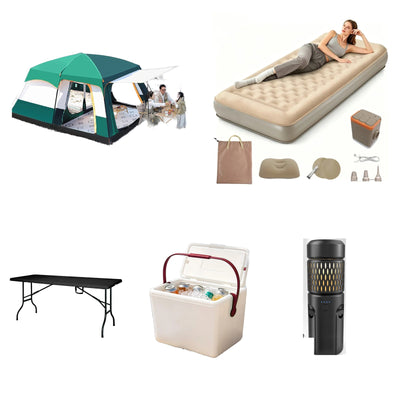
For camping in Central Europe, 3000 mm on the outer tent is considered solid, 2000 mm as the lower limit. The water column indicates how high a column of water could stand on the fabric before water penetrates. More important than a very high number are sealed seams - water will run through a leaky seam regardless of the fabric.
Rechne bei Herstellerangaben mit einer Person weniger, als draufsteht. Die Personenzahl beschreibt Schlafplätze nebeneinander — ohne Gepäck und mit rund 55 cm Breite pro Person. Für vier Personen mit Ausrüstung ist ein Fünf- oder Sechs-Personen-Zelt angenehmer.
Kuppelzelte stehen frei und lassen sich auch auf hartem Boden aufstellen, Tunnelzelte bieten mehr nutzbare Fläche, müssen aber abgespannt werden. Die Kuppelform trägt sich selbst, weil sich die Stangen kreuzen. Der Tunnel nutzt die Grundfläche besser und hat meist mehr Stehhöhe.
Als Faustregel einen Hering je Abspannpunkt plus vier Ersatz. Die mitgelieferten Heringe sind bei günstigen Zelten oft dünn und verbiegen auf steinigem Grund. Wer häufig auf hartem Boden steht, fährt mit Schraubheringen besser — die drehen sich hinein, statt sich beim Schlagen zu verformen.